
We pray.
My book comes out in 1.5 days. My tumor comes out in 16.

Paid subscribers, you can listen to me narrate this essay here.
My book comes out in 1.5 days.
My tumor comes out in 16.
Today, I wept in a pew, grief releasing like rain right along with a rising comfort I can only describe as faith.
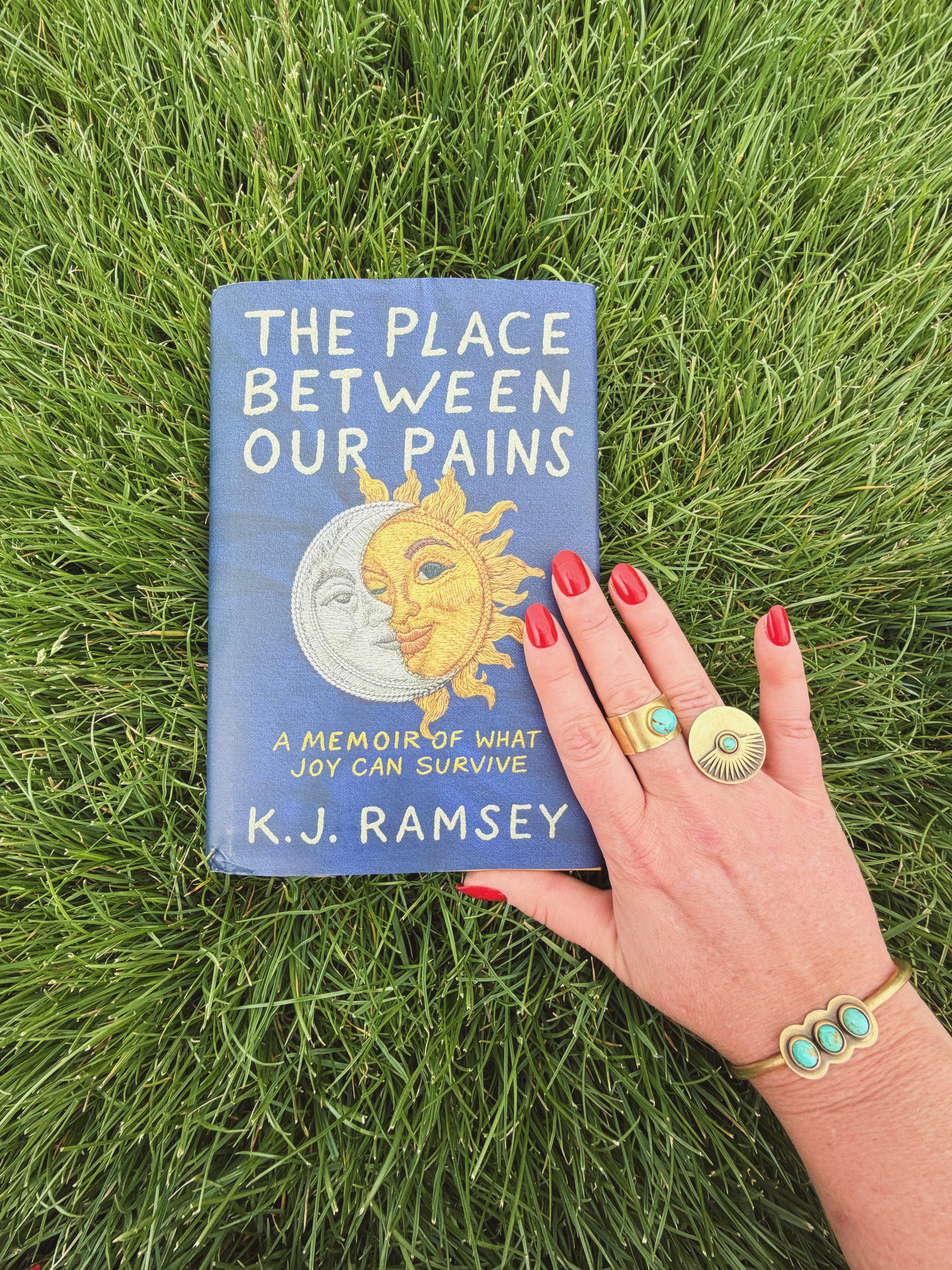
When I didn’t die, I was left with a life I wasn’t sure I could bear living.
I screamed in bed at night from bone pain so haunting and fierce that I couldn’t have held back my involuntary shrieks and moaning even if I tried. It was so horrific that I didn’t realize a human could hold that much pain in their body and not die.
I wanted to die. Or, more accurately, I wanted relief. And when no answers were coming from anyone in a white coat, for months upon months, all I could see were endless dark days splayed out ahead of me, of a life in bed as a shell of my former self, in a body so swollen by steroids neither my phone nor my brain could recognize me, too brokenhearted to try believing in anything beyond the fact of my own next breath.
Do you know pain so fierce you aren’t sure you can bear living with it? Have you faced a future so cloaked in cruelty that you aren’t sure you can step toward it?
I ask because I already know the answer. At least for many of you. I’m not that special, even if my rare medical situations are.
Despair isn’t defeat. Feeling it doesn’t make you a failure.
It makes you human.
Last week I stood at the top of the marble stairs at Mayo Clinic (MN) and watched while the last patients of the day shuffled or wheeled their way to home or hotels. I could almost see myself, there for the first time 2.5 years ago, slumping in a wheelchair pushed by my husband, wondering if all the money we spent to get there would even be worth it, desperate to hope that it would.
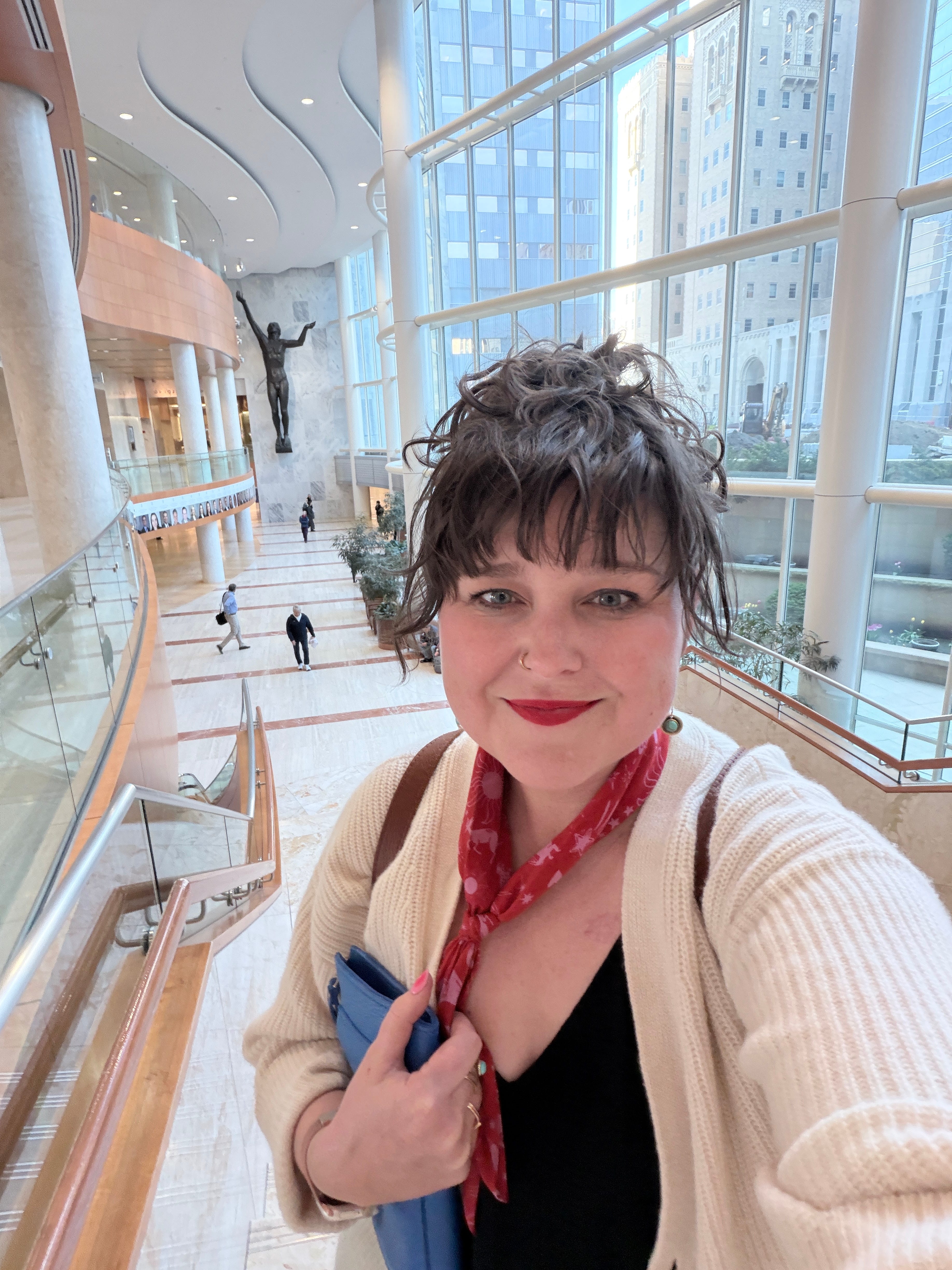
I didn’t expect to return to Mayo before my book in which Mayo is a frequent location even publishes, but at this point, my life is kind of a giant explosion of any expectations—like fireworks but there are no oooohs and aaaaaahs, just tears and many inappropriate jokes.
We were at Mayo to meet my team of surgeons, two of the world’s leading experts in rare face tumors and facial reconstruction.1 I’m grateful I could get in so quickly, because it turns out that after my partial resection surgery, my tumor got more pissed than I am about my hijacked book launch and grew back with a vengeance. Now, three new structures of my face are being destroyed while I sit here typing to you, and the most disturbing part might not be that I don’t know what my face will look like when this is all over but that I can feel the tumor growing pulse by pulse, at all hours, aching while it eats the only face I’ve ever known. Sigh. Life is very strange right now.2
The best part of being at Mayo wasn’t that my face is literally in good hands. It wasn’t even that I also got to see my orthopedic surgeon beaming. The smile on his face was huge—and this man is stoic!—as we looked at the scans of my distal femurs after two major surgeries and hyperbaric oxygen therapy.
It’s rare to get Avascular Necrosis; it’s even rarer to heal at all from it.

My surgeon almost never gets to see patients heal this much. He showed me my scans side by side: my lesions of necrotic bone have shrunk. Substantially. There’s still death inside my bones. I’ll still need new knees someday, maybe even soon. But there is less dead inside me than there was when I first met him.
I am far from where I want to be and I walk and stand more now than I could have imagined was possible for me on the day I first learned bone death was even possible and had happened to me.
That was almost the best part of my visit to Mayo.
But the real best part was carrying the long, hard path of healing downstairs with me, to the subway level, into a windowless room, much like a womb.
When I wasn’t sure I could bear the pain of living, I decided to not judge the pain of feeling like I was losing my faith. I had lost most of my mobility, my ability to recognize my own body, half of my hair, and my ability work as a therapist.
The best choice I ever made in the darkness was to not judge the light’s existence.
After sitting in the world’s weirdest photo studio to get Medical Mug Shots taken so the geniuses at Mayo can create a 3D model of my entire face to guide my surgery, I wandered downstairs to a room that’s in one of my favorite parts—and one of the hardest parts—of my memoir.


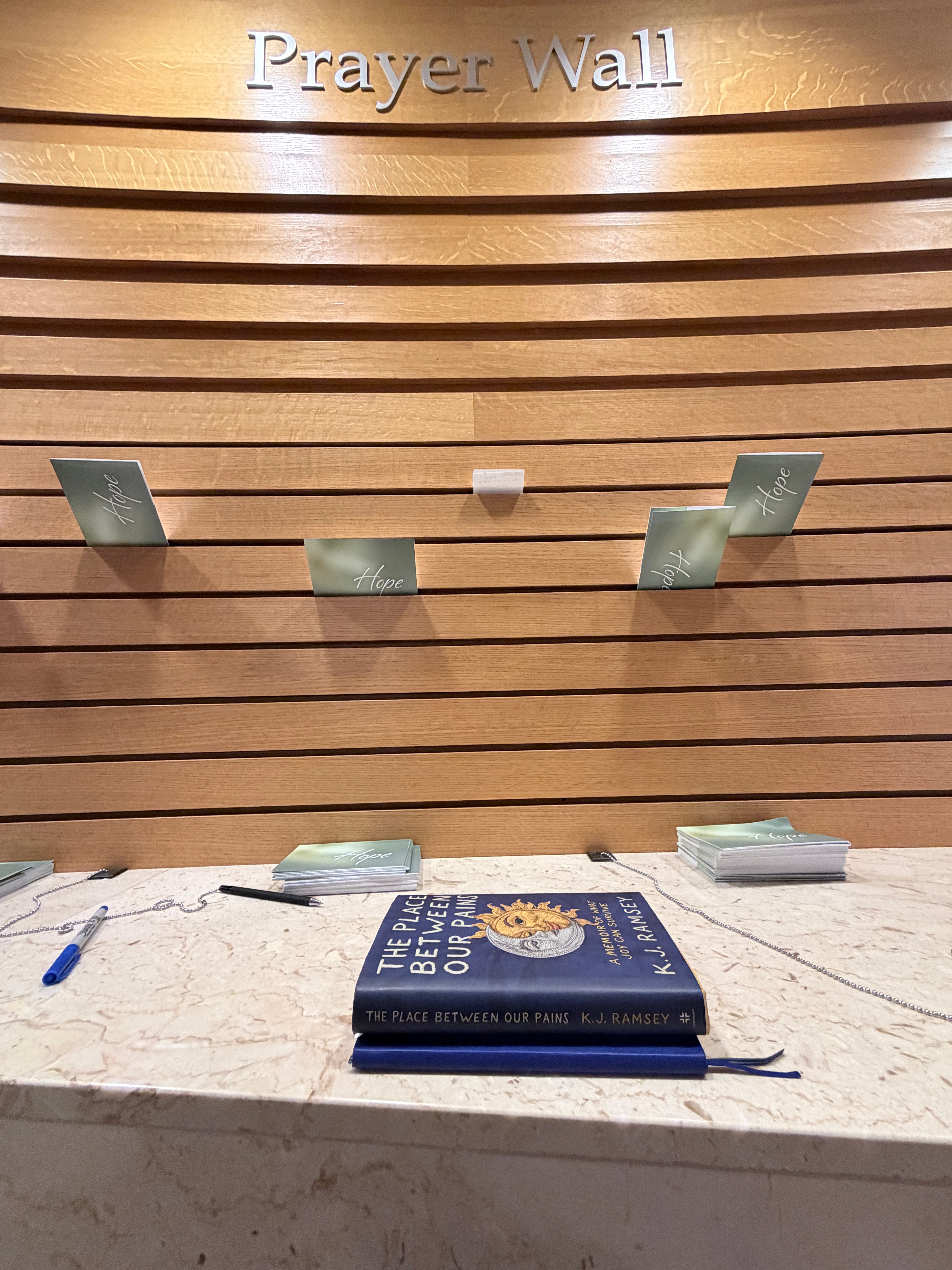
I clutched The Place Between Our Pains to my chest as I entered Mayo’s Center for the Spirit. I didn’t expect to get this moment—a chance to revisit a place that held me when I was almost hopeless. A moment to haunt the self who wasn’t sure she could keep living with the fact that she did anyway.
I slipped off my shoes beside others’, bowing in respect to the sound of salah being prayed just beyond the blue, swirled glass wall. I stood before the prayer wall, a simple wall of wooden slats, dotted with a small constellation of folded notes. Prayers for healing. Pleas. Each one placed by hands that are as precious as mine.
I opened The Place Between Our Pains to a chapter I’ll share with you now. Some of you may have already read it. Feel free to skip ahead.
The best part of this story is what comes after.
WE PRAY
an excerpt from The Place Between Our Pains
I just finished an appointment with a medical geneticist, a kind woman who validated the reality that my family medical history lights up bright as the huge Christmas trees in the lobby, but with diseases and disorders no one can explain. She believes there must be a strong genetic component to our family story of illness and would like to sequence my genome and my sister’s—though she warned that few of her autoimmune patients receive answers that way.
When this appointment was added to my schedule, I sent Ryan home without me. He’s already had to use so much family medical leave for me, and I figured I could handle a genetics appointment alone. Maybe an ortho appointment will get added, too, but I’m not banking on it.
I step through an automatic door into a quiet, dark room. I clutch my cane for support and glance around Mayo’s Center for the Spirit. Beige carpet swirls with tan into a large spiral that meets in a small circular gathering space sheltered by ocean-blue stained-glass panels. I’m pulled like a magnet to the wooden wall on my right, stacked with simple horizontal slats filled with scraps of white paper tucked inside. It’s a prayer wall.
I’ve barely prayed in months. My life seems locked in some liminal phase. Weeks and months pass, but this sickness just hasn’t. I am stuck, spending nearly every hour of my life in bed while everyone else gets to have a life. I exist in the dark, shrouded by the disappointment of nearly no improvement. Sometimes, despair is my closest companion. Sometimes, I wish I’d let my throat close. I was afraid of dying, and now I’m afraid of living the life I was left with.
My life and faith have been emptied of everything but rest. I cry to a void I barely can name, a God who has gone silent. And I know God is not some gas that fills our voids nor a genie who grants our wishes. But maybe God is the ground beneath our grief.
I haven’t stopped believing in God. I’ve stopped trying to bud belief in the bitter cold. I haven’t forgotten my faith. I’m letting it lie fallow.
For so long, I’ve felt like a seed trapped in bad soil, but in this dark, womblike room tucked between the hallways of Mayo, I can see that my suffering is shared. Every scrap of paper tucked into this prayer wall is proof of a person like me, planted in pain, connected by sorrow. The wood-paneled wall is a web.
I take out a pen and write a prayer on one of the scraps stacked on the counter.
Breathe life back
into my every bone.
Revive my spirit.
Grant me determination
and courage
for the road ahead.
Sustain and heal me, O God.
Amen.
I fold the small slip of paper in half and place my prayer in the wall, trusting beyond trauma that my separateness is the real illusion.3
I had decided that day—in that room—that if the story of Jesus and faith is true, then it will rise back up from the dead in me when it damn well pleases.
I’m so glad I made that choice. Not because faith is better than doubt or belief is a bedrock on which a life must be built to be good but because there are invisible forces holding us up that we can’t see except in hindsight.
I stood in front of the wooden wall and traced my finger over the prayer on the printed pages of my book—the prayer I scrawled onto a piece of a paper in December 2023 two days before learning why I screamed in bed each night and could barely walk, two days before learning a bone had died—and something hard inside me split open.
Just like a seed.
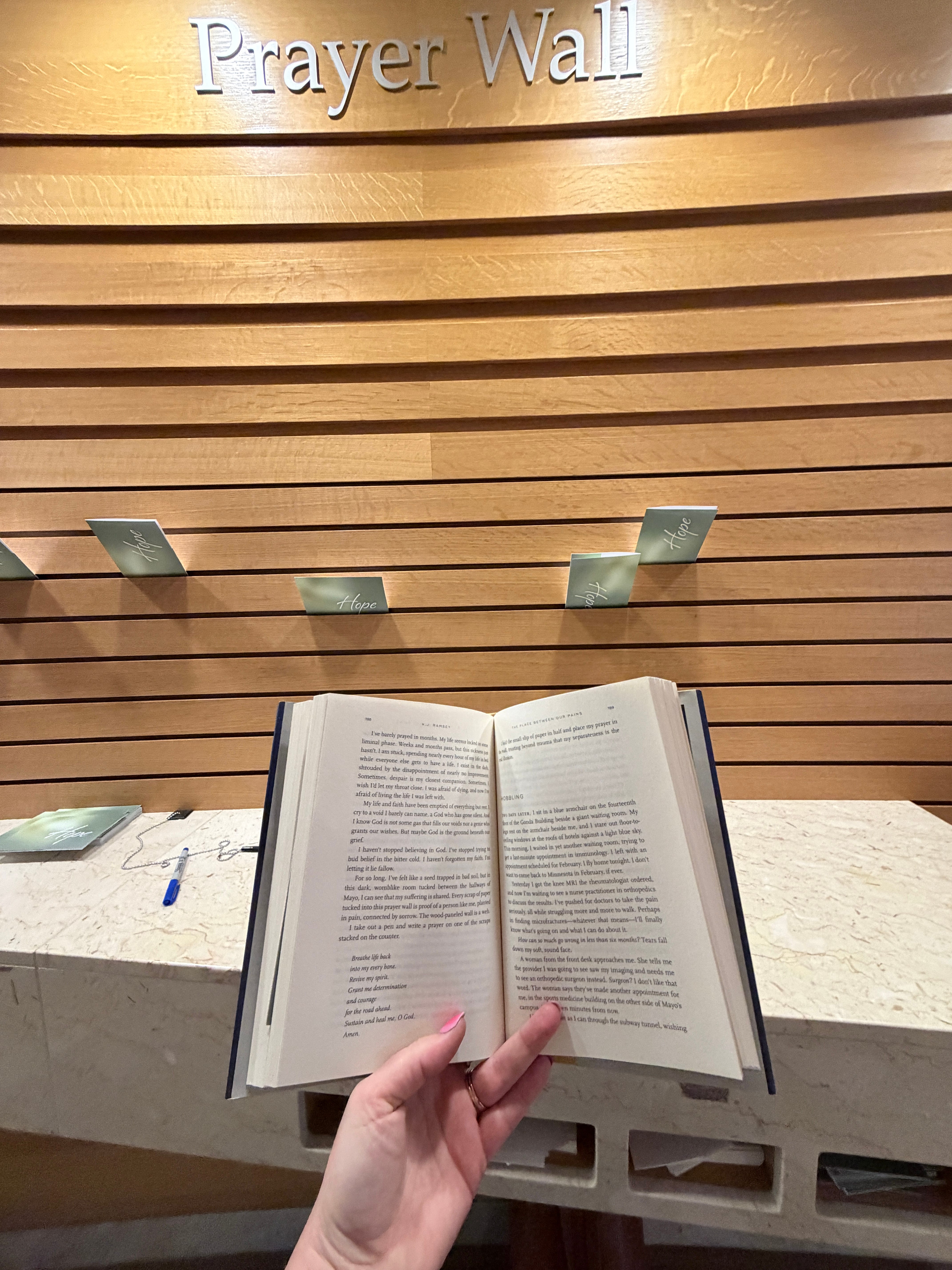
There are few moments in life when we get to see time and space fold into one whole, when, like children, we overhear the whispers of what I might dare to call heaven, when the hopes that took every cell of courage we had to write down are somehow shown to have not been futile but actual faith, realer and more lasting than necrotic lesions, truer than the rage of all that was ruined.
I stood before that wall pulsing with wonder, holding a hand to my ever-aching tumor, my body full of frisson that after everything and in everything that still hurts like hell, I am companioned. I am held. And I am upheld.
I was upheld even when I could barely hold a bible—well, I still barely can. I was upheld when I couldn’t hear a prayer without cringing. I was upheld when words about God started to sound like gibberish. I was upheld when I yelled. I was upheld when I raged. I was upheld when I longed for the bliss of not breathing one day.
I was never alone in the dark. Even when God had gone silent.
And it wasn’t just God with me there. It was the web of the wounded and weary. It was the mystery, like mycelium, of how even in our solitary, sad beds and hospital rooms we are actually woven together in ways we sometimes can only see on a prayer wall in a desperately hard place to have to go.
I set down my book and wrote a new prayer.
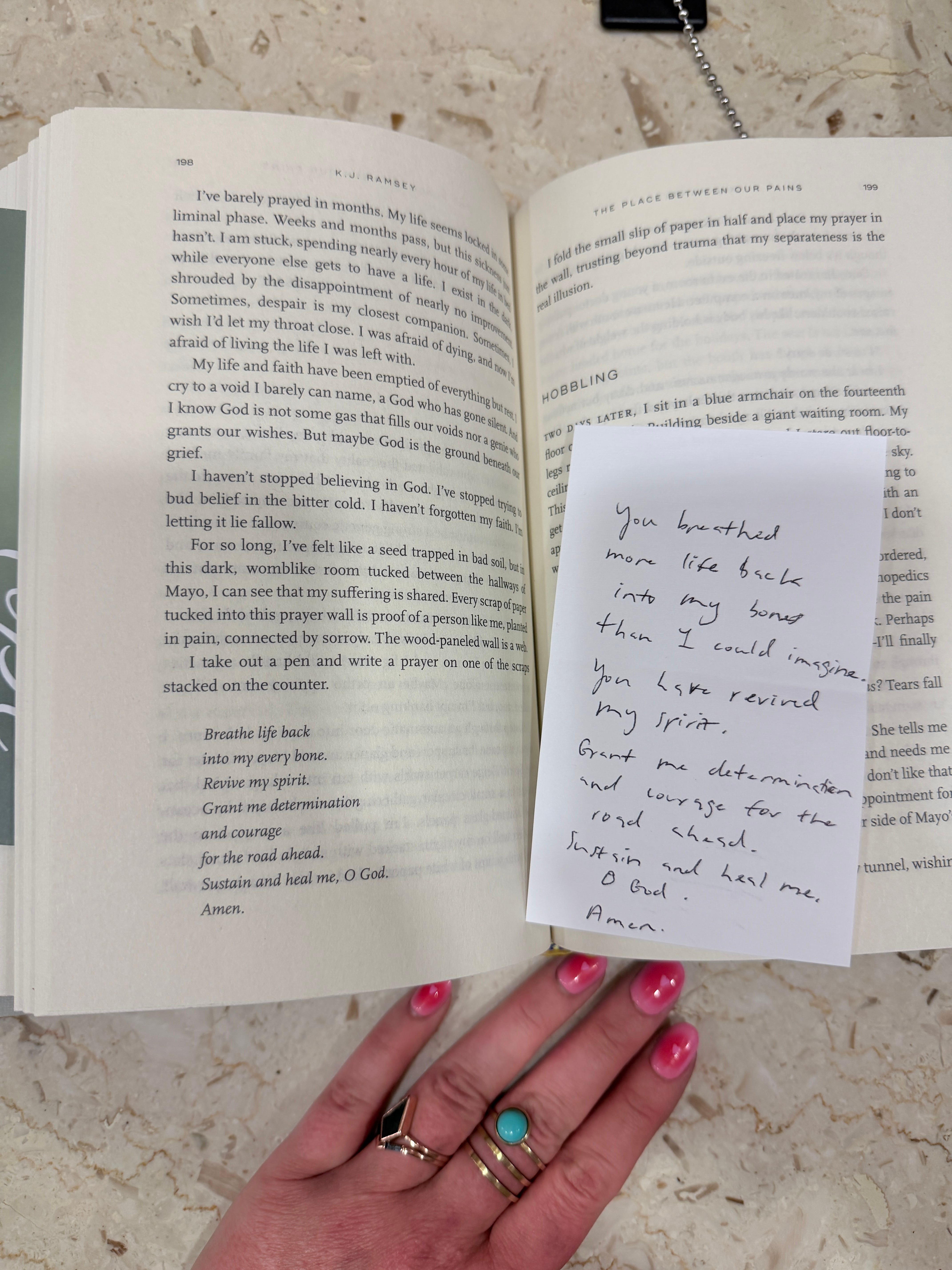
You breathed more life
back into my bones
than I could imagine.
You have revived my spirit.
Grant me determination
and courage
for the road ahead.
Sustain and heal me, O God.
I sat on the floor of that room for a long time, holding the evidence of hope in one hand and the hard need for trust in the other. I thought about surgery. I thought about my book launch, and how truly disappointing it is to be staring down major surgery not cameras for tv interviews or podcast mics to promote the thing I worked so hard to make. And as tears streamed down my face, I smiled. Grief and joy, all at once.
Maybe healing was never about the reversal of disease or a return to the life or even faith I once had but expanding to receive the whole range of human experience and bless every fucking speck of it as sacred.
Maybe you don’t have to keep exhausting yourself trying to eliminate everything that hurts. Maybe, you can hold it all with tenderness and strange, unexplainable hope—the hope you don’t even feel like you have—trusting even the tiniest bit, in the angriest or most apathetic way, that a miracle is going to happen whether it looks like you want it to or not.
The miracle was never about no longer being miserable. The miracle was always about being fully human.
Before I left that room and Mayo, I wrote one more prayer. For you.
For those who read my story,
give them hope
beyond their hurt.
Give them faith
that outlives
every question.
Show them the miracle
of being sustained.
Give them joy
amid pain.
Amen.
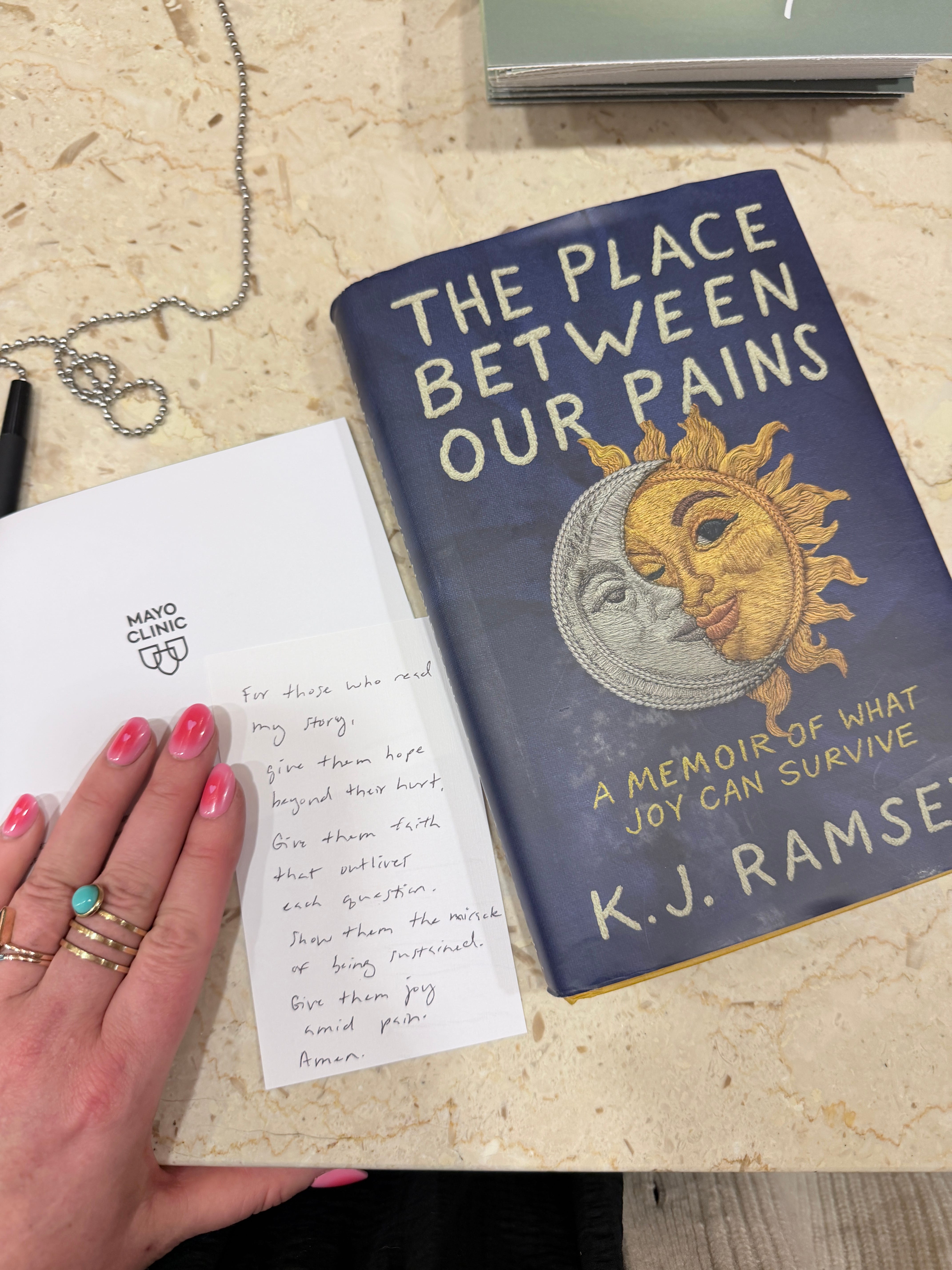
The Place Between Our Pains: A Memoir of What Joy Can Survive publishes on Tuesday.
Which means, if you order a copy right now, you will get it in just a couple days.
It’s the best thing I have to give you to find your own way through the dark. It’s silly. It’s sad. It’s angry. It’s honest.
And, it’s how I can face what’s ahead and smile.
Because joy isn’t what you expect.
It’s far more feral than that.
It’ll find you. It’ll haunt you. It’ll hold you.
Joy will frustrate you, like it’s frustrating me right now, coming not in the absence of pain but right in the ugly middle of it.
Let me tell you a story of how feral joy is, how precious life is, and how much goodness exists right in the middle of the grief that won’t go away.
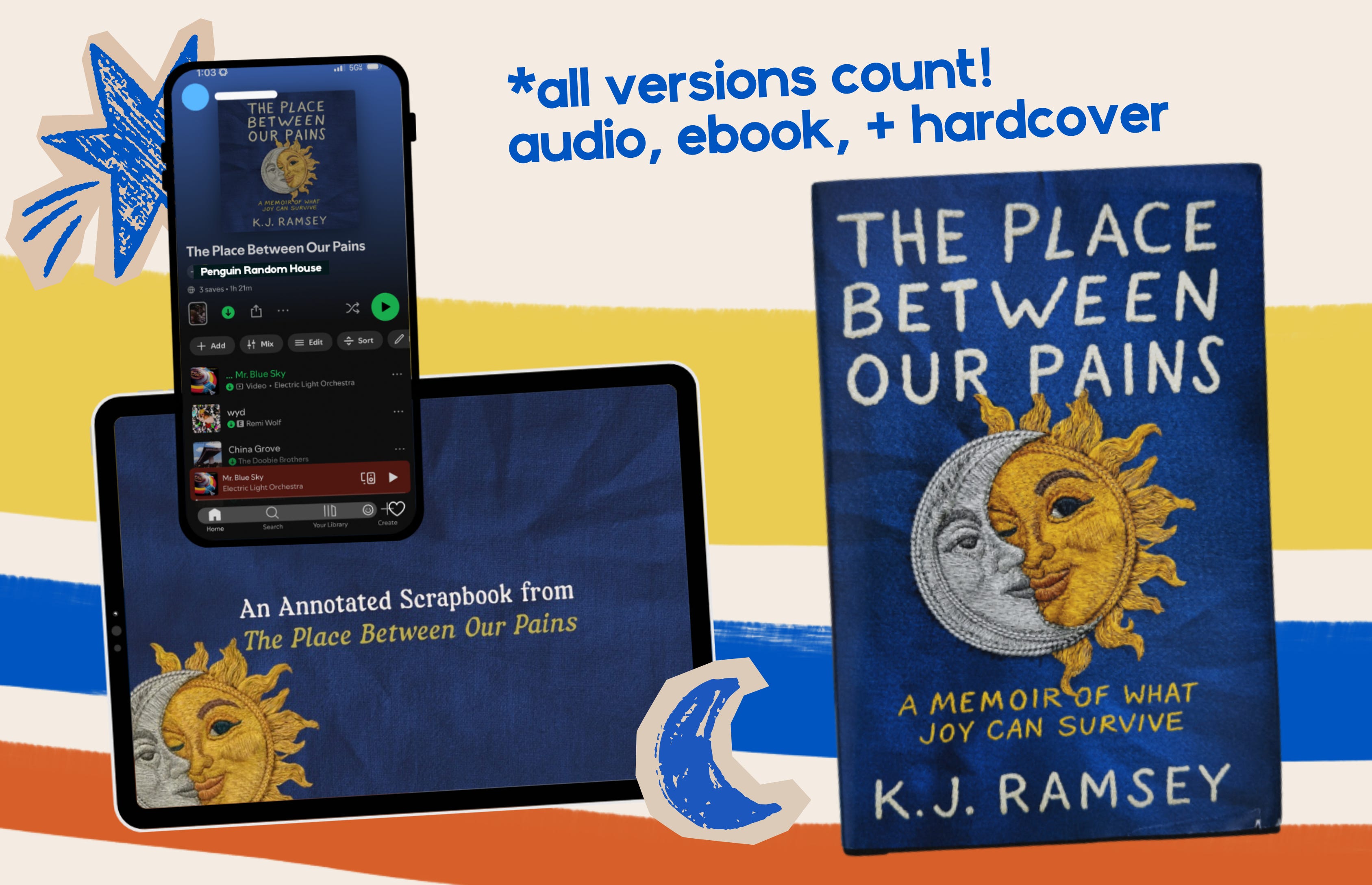
P.S. If you buy a copy before Tuesday, you can still claim some preorder bonuses. 👇🏼
I made a digital scrapbook that’s super fun. Lots of behind-the-scenes photos and thoughts, spanning each part of the book. There’s also a playlist, which is basically a soundtrack to the book. Songs that show up in the story and the songs I wrote so much of the book to, dancing like a fool or weeping while I typed.
Dr. Eric Moore and Dr. Michael Olson. Sometimes I like to share these details, like breadcrumbs for the next brokenhearted baddie finding their way through the strange dark woods of complex, rare disease.
I’m tired of writing about tumor details. For those wondering, surgery is on June 4th at Mayo. I’m in my sister’s wedding May 30th in Montana, then we fly home to Colorado, and I’ll get up and have IVIG less than 10 hours later, and the moment my nurse removes my IV, we’ll head to the airport to make it to my surgeons’ offices at Mayo the next morning for pre-op. I do not know how I will do this except that technically, the schedule is possible by mere hours. But is the energy? Let’s hope. The next three weeks of my life are the weirdest.
K.J. Ramsey, The Place Between Our Pains: A Memoir of What Joy Can Survive (New York: Convergent, 2026), 197-199.
If hope is a team sport, and I believe it is, I don’t just wear the team hat, I hold you in my heart and in my prayers as I watch from the sidelines (with great hope) as you enter this next inning. 🙏❤️❌⭕️
“I’ve stopped trying to bud belief in the bitter cold. I haven’t forgotten my faith. I’m letting it lie fallow.”
Thank you for these words and the freedom they give me to let my faith lie fallow at times when the pain and silence feels oppressive. This imagery releases so much shame. Your writing is such a gift to all of us, and I hate the nonstop pain you are enduring. ❤️